
Chronic kidney disease (CKD)
Medically reviewed by Dr. Dragoș Fășie, senior specialist in nephrology, general ultrasound, NOVOMED CLINIC ConstanțaUpdated: October 3, 2026 · 6 min read
What is chronic kidney disease and why do we call it a “silent disease”?
Chronic kidney disease means kidney damage or reduced kidney function that lasts more than 3 months; it often worsens slowly, over months or years. In the early stages, blood and urine tests may show only small changes, but over time the gradual loss of nephrons reduces the kidneys’ ability to filter the blood. When kidney function reaches a critical point, the patient may need dialysis or a transplant. The severity of the disease is assessed by the estimated glomerular filtration rate (eGFR) and by the amount of albumin lost in the urine, the two key markers used to stage it.
Contents (5 sections)
According to recent data, worldwide:
- Almost 800 million adults live with CKD, and the number has doubled since 1990.
- CKD is now among the top 10 causes of death worldwide, responsible for about 1.5 million deaths a year.
- In Romania, data show an estimated prevalence of up to 10% in the adult population, most of it undiagnosed.
Chronic kidney disease: what causes it?
The main risk factors
In the vast majority of cases, CKD does not appear “out of nowhere.” There are a few well-documented main causes and risk factors:
a) Diabetes
It is the most common cause of CKD worldwide. Over time, high blood sugar damages the blood vessels and the fine filtering structures (glomeruli) in the kidneys. Without good blood sugar control, the risk of CKD rises considerably.
b) High blood pressure
High blood pressure directly damages the kidneys’ blood vessels, causing them to narrow and harden over time. High blood pressure is both a cause and a consequence of kidney disease, creating a cardiorenal vicious cycle.
c) Obesity and metabolic syndrome
Excess weight, especially around the waist (abdominal obesity), is associated with insulin resistance, chronic inflammation, high blood pressure and abnormal blood lipids, all of which raise the risk of CKD. Recent global analyses show that metabolic factors (diabetes, high blood pressure, obesity) are the main drivers of CKD.
d) Other important causes
- Glomerular diseases (autoimmune or post-infectious glomerulonephritis)
- Polycystic kidney disease (inherited)
- Overuse of nonsteroidal anti-inflammatory drugs (NSAIDs) and other medicines that can damage the kidneys
- Exposure to toxins, heavy metals and some chronic infections
Many cases could be prevented or delayed if these factors were controlled earlier.
Chronic kidney disease: how can it be found early?
Screening for people at risk
The good news is that CKD can be detected easily, with routine tests, long before symptoms appear. International guidelines (KDIGO, diabetes and cardiology societies) recommend targeted screening for people at higher risk.
Who should be tested regularly?
- People with diabetes (type 1 or 2)
- People with high blood pressure
- People with obesity or metabolic syndrome
- Older adults (over 50-60)
- People with a family history of kidney disease
- People with cardiovascular disease (heart attack, heart failure, stroke)
Which tests matter?
- Serum creatinine and the calculated eGFR (estimated glomerular filtration rate): they show how well the kidneys filter.
- Urine test with measurement of protein/albumin in the urine: protein in the urine is an early sign of kidney damage.
- If needed, a kidney ultrasound to assess the structure of the kidneys.
Staging CKD
The KDIGO guideline classifies CKD using two pillars:
- G1-G5 by eGFR (kidney function):
- G1-G2: near-normal function, but with other signs of kidney damage
- G3a-G3b: moderately decreased kidney function
- G4: severely decreased
- G5: kidney failure (dialysis or a transplant may be needed)
- A1-A3 by albuminuria (how much protein is lost in the urine):
- A1: normal to mildly increased
- A2: moderately increased (formerly “microalbuminuria”)
- A3: severely increased (formerly called “macroalbuminuria”)
This staging helps the doctor assess the risk and decide how intensive treatment and monitoring should be.
Chronic kidney disease: how can its progression be slowed or prevented?
Not all cases of CKD can be prevented (genetic forms, for example), but most can be significantly delayed with a combination of a healthy lifestyle and the right treatment.
a) Good control of diabetes and blood pressure
- HbA1c targets adapted to age and other conditions, to avoid blood sugar spikes.
- Keeping blood pressure below 130/80 mmHg in patients with diabetes and CKD, as modern guidelines recommend.
- Using medicines with a heart- and kidney-protective effect (for example SGLT2 inhibitors and drugs that block the renin-angiotensin system), as prescribed by a specialist.
b) Weight control and lifestyle
Gradual weight loss is essential for patients with obesity, and even losing 5-10% of body weight can bring significant benefits for kidney health. A balanced diet remains a central pillar of prevention: less salt, sugar and saturated fat, enough protein but not too much (especially in advanced stages), and plenty of vegetables, fruit and whole grains. Add regular physical activity adapted to your age and health, such as at least 30 minutes of brisk walking on most days of the week, a routine that directly supports kidney and metabolic health.
c) Avoiding substances that harm the kidneys
- Limit long-term use of nonsteroidal anti-inflammatory drugs (ibuprofen, diclofenac, etc.), especially in older adults and in people with CKD, diabetes or heart failure.
- Be careful with “natural” supplements without clear studies, which may contain substances toxic to the kidneys.
- Tell your doctor about all the medicines and supplements you take.
d) Regular monitoring
People at risk or with known CKD should have regular check-ups with their family doctor, diabetes specialist, cardiologist and, ideally, a nephrologist (see nephrology at NOVOMED CLINIC), depending on the stage. The aim is to:
- adjust the treatment;
- detect complications early (anemia, mineral and bone disorders, fluid retention);
- plan dialysis or a transplant in good time, if it becomes necessary.
Long-term management
In CKD, we talk less about “quick fixes” and more about a long-term strategy, tailored to each patient.
a) Targeted medication
- Medicines for blood pressure, preferably drugs that block the renin-angiotensin system (ACE inhibitors, ARBs) when tolerated;
- Newer kidney-protective medicines: SGLT2 inhibitors, for many people with CKD, with or without diabetes, and, in type 2 diabetes, some GLP-1 receptor agonists, as recommended by guidelines;
- Treatment for anemia, calcium and phosphorus disorders and metabolic acidosis, as needed.
b) Professional nutrition support
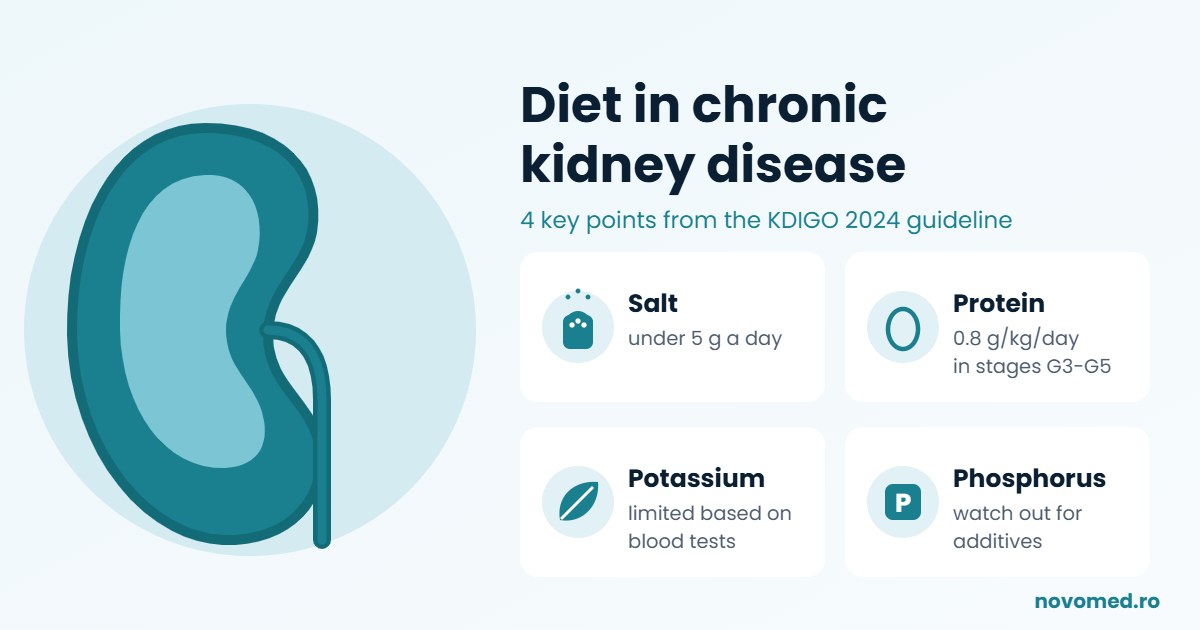
A diet for a patient with CKD is not just “no more salt”. Needs vary with the stage, potassium, phosphorus and whether diabetes is present. That is why working with a nephrologist and a dietitian experienced in kidney disease is essential. The practical targets, stage by stage (salt, protein, potassium, phosphorus), are explained in our article on diet in chronic kidney disease.
c) Dialysis: when the kidneys can no longer cope
In stage 5 (G5), when eGFR falls below about 15 mL/min/1.73 m² and symptoms of uremia appear, kidney replacement therapy is needed:
- Hemodialysis (usually in a specialized center, 3 times a week);
- Peritoneal dialysis (can be done at home, for suitable patients).
Dialysis does not cure kidney disease, but it takes over part of the kidneys’ work and prolongs life.
d) Kidney transplant: the best option, when possible
A kidney transplant, from a living or deceased donor, currently offers the best quality of life and long-term survival compared with dialysis.
Not all patients are eligible, but for those who are, the discussion about a transplant should start early, not in a hurry when the disease suddenly worsens.
If you have diabetes, high blood pressure or a family history of kidney disease, talk to your doctor about kidney screening tests. Do not wait for symptoms: in CKD, by the time symptoms appear, the disease is often advanced.
References (articles and guidelines)
- KDIGO 2024 Clinical Practice Guideline for the Evaluation and Management of Chronic Kidney Disease. Kidney International, 2024 – https://pubmed.ncbi.nlm.nih.gov/38490803/
- Cockwell P, Fisher L-A. The global burden of chronic kidney disease. Lancet, 2020 – https://pubmed.ncbi.nlm.nih.gov/32061314/
- Global burden of chronic kidney disease and risk factors. Frontiers in Public Health, 2025 – https://www.frontiersin.org/journals/public-health/articles/10.3389/fpubh.2025.1542329/
- Chronic Kidney Disease and Risk Management. Standards of Care in Diabetes, Diabetes Care, 2025 – https://diabetesjournals.org/care/article/48/Supplement_1/S239/157554/11-Chronic-Kidney-Disease-and-Risk-Management/
- Boala cronică de rinichi: o epidemie tăcută între bolile cardio-renale-metabolice (in Romanian). Boehringer Ingelheim Romania – https://www.boehringer-ingelheim.com/ro/medicina-umana/boli-renale/boala-cronica-de-rinichi-o-epidemie-tacuta-intre-bolile-cardio-renale-metabolice
- Ziua Mondială a Rinichiului: Boala cronică de rinichi este a opta cauză de deces la nivel mondial (in Romanian). formaremedicala.ro – https://www.formaremedicala.ro/ziua-mondiala-a-rinichiului-boala-de-rinichi-este-a-opta-cauza-de-deces-la-nivel-mondial/
About the authorDr. Dragoș Fășie, senior specialist in nephrology, general ultrasound, sees patients at NOVOMED CLINIC Constanța (by appointment). See the doctor’s profile.



 Copyright © 2026 BEST HEALTHCARE SYSTEM SRL, tax ID 38945184, Trade Register J2018000506130, Str. Soveja nr. 78, Constanța