
Why urine pH matters in kidney stones
Medically reviewed by Dr. Dragoș Fășie, senior specialist in nephrology, general ultrasound, NOVOMED CLINIC ConstanțaUpdated: October 3, 2026 · 4 min read
What is urine pH?
Urine pH shows how acidic or alkaline your urine is and is measured on a scale from 0 to 14.
Contents (6 sections)
A pH below 7 means acidic urine.
A pH of 7 means neutral urine.
A pH above 7 means alkaline urine.
Urine pH normally varies during the day, depending on what you eat, how much you drink and your metabolism. However, when certain values persist over a long time, they can favor the formation of specific types of kidney stones.
In kidney stone disease, pH directly affects how well mineral salts dissolve and the process of crystallization. In other words, it helps determine whether certain substances stay dissolved in the urine or turn into crystals that can lead to kidney stones.
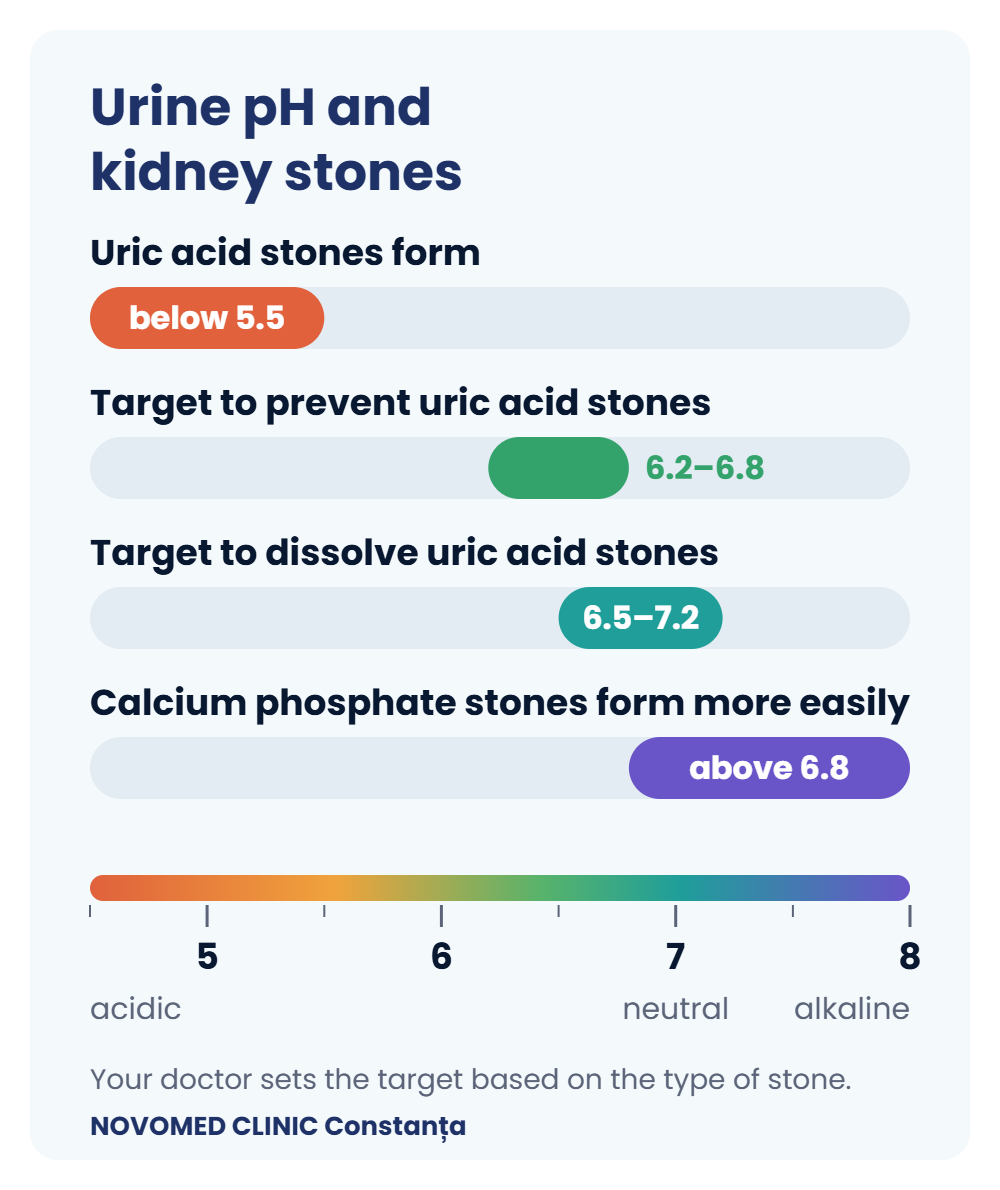
How pH relates to the type of kidney stone
The type of kidney stone is closely linked to the chemistry of the urine. That is why urine pH is essential in preventing and treating kidney stones.
Uric acid stones
These stones form in acidic urine, especially when the pH is below 5.5.
Making the urine more alkaline, to values between 6.5 and 7.2, can even dissolve uric acid stones, which makes adjusting the pH an important part of treatment.
Calcium oxalate stones
These are the most common kidney stones and can form across a wide range of pH.
In people with low levels of citrate in their urine, citrate therapy lowers the risk of crystallization, because citrate is a natural inhibitor of stone formation; it also raises urine pH, usually to about 6-6.5.
Calcium phosphate stones
These stones form more often in alkaline urine, usually at a pH above 6.8.
In these cases, making the urine too alkaline should be avoided.
Infection stones (struvite)
Struvite stones usually form in the setting of urinary tract infections caused by urease-producing bacteria. These bacteria change the urine and keep its pH persistently alkaline, which favors stone formation.
What is the best urine pH in kidney stone disease?
There is no single urine pH value that suits every patient. The target is set according to the composition of the stone and the patient’s urinary metabolic profile.
In practice:
- Uric acid stones: target pH 6.2-6.8 to prevent new stones (6.5-7.2 to dissolve existing ones)
- Calcium oxalate stones: no fixed pH target; with citrate therapy, urine pH usually rises to about 6-6.5
- Calcium phosphate stones: avoid making the urine too alkaline
Urine pH should be adjusted under medical supervision, because incorrect changes can favor other types of stones.
How is urine pH monitored?
Monitoring urine pH is relatively simple and can be done in several ways:
- urine test strips, used at home;
- urinalysis, done in the laboratory;
- 24-hour urine metabolic profile, which gives detailed information about the composition of the urine.
Patients with recurrent stones (repeated episodes of kidney stones) usually need a full metabolic assessment, to identify the factors that favor stone formation and to set a personalized prevention plan.
Medical ways to keep urine pH in the right range
Urine pH is controlled through a combination of hydration, diet and medication, adapted to each patient.
Drinking enough
A urine volume of more than 2-2.5 liters a day reduces the supersaturation of mineral salts and, with it, the risk of crystallization.
In short, drinking enough dilutes the substances in the urine that can form stones.
A personalized diet
Diet plays an important role in urine pH balance.
- For uric acid stones, eating fewer purines (red meat, organ meats) and more vegetables is recommended.
- For calcium phosphate stones, it is important to avoid making the urine too alkaline and to treat urinary tract infections.
The eating plan should be based on the type of stone and on each patient’s particular situation.
Citrate therapy
Citrate therapy is often used in the management of kidney stones.
Potassium citrate has two main effects:
- it makes the urine more alkaline
- it raises the concentration of citrate in the urine, which inhibits stone formation
How it works
Citrate-based preparations help to:
- make the urine more alkaline
- raise the concentration of citrate in the urine
- reduce the formation and clumping of calcium oxalate crystals and help keep uric acid dissolved
These effects help prevent new stones and lower the risk of recurrence.
Common uses
Citrate therapy is used in uric acid stones, calcium oxalate stones, hypocitraturia (low urinary citrate) and preventing recurrence after stones have been passed or removed.
Potassium citrate preparations are used for this purpose, as part of the prevention plan.
Precautions
Taking citrate needs a medical assessment, especially in patients with:
- severely reduced kidney function
- high blood potassium (hyperkalemia)
- ongoing treatment with potassium-sparing diuretics
Urine pH is a key factor in preventing and treating kidney stones. Careful monitoring, enough fluids, a personalized diet and citrate therapy can significantly lower the risk of recurrence.
The assessment and the treatment plan should be made during a urology consultation and adapted to each patient’s metabolic profile.
A metabolic assessment and monitoring of urine pH can identify the factors that favor kidney stone formation.
Medical sources
About the authorDr. Dragoș Fășie, senior specialist in nephrology, general ultrasound, sees patients at NOVOMED CLINIC Constanța (by appointment). See the doctor’s profile.




 Copyright © 2026 BEST HEALTHCARE SYSTEM SRL, tax ID 38945184, Trade Register J2018000506130, Str. Soveja nr. 78, Constanța