
JJ stent: when it is needed, how long it stays in and symptoms
Medically reviewed by Dr. Remus Ilie, specialist in urology, general ultrasound, NOVOMED CLINIC ConstanțaUpdated: October 3, 2026 · 6 min read
A JJ stent (also called a ureteral stent) is a medical device often used in urology to keep urine draining from the kidney to the bladder. Although placing it is a routine and safe procedure, having a JJ stent can cause symptoms that worry patients. In this article we explain clearly when a JJ stent is needed, how long it stays in and what symptoms can appear, as well as when you need to see a doctor.
Contents (11 sections)
- The JJ stent (ureteral stent): what is it?
- When is a JJ stent needed?
- How is a JJ stent placed?
- How long does a JJ stent stay in?
- What symptoms can a JJ stent cause?
- How to ease the symptoms caused by the stent
- Living with a JJ stent: work, exercise, sex, travel
- When should you see a doctor urgently?
- Removing the JJ stent
- What happens if the stent stays in too long
- Frequently asked questions about the JJ stent
The JJ stent (ureteral stent): what is it?
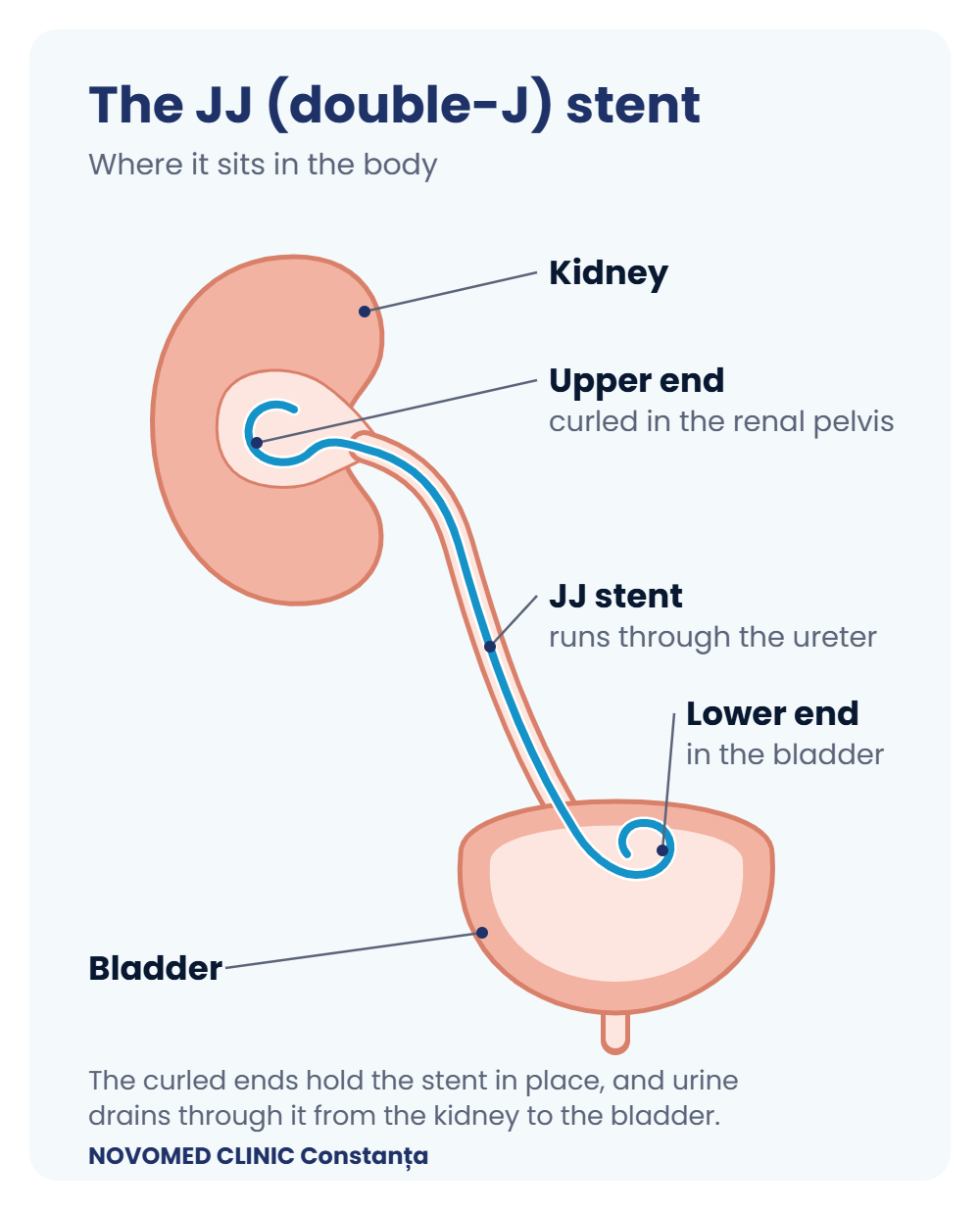
A JJ stent is a thin, flexible tube placed in the ureter to keep the urinary tract open and let urine drain normally. The name “JJ” comes from its shape, curved at both ends, which holds it in place in the kidney and in the bladder and keeps it from moving.
The stent cannot be seen from the outside and does not affect how the kidney works. It is temporary and is used to prevent or treat a blockage of urine flow.
When is a JJ stent needed?
A JJ stent is placed in several urological situations. Most often, it is used after ureteroscopy or flexible ureterorenoscopy to treat kidney stones. It may also be needed when the ureter is blocked by a stone, when the ureter is inflamed or swollen, in complicated urinary tract infections or after certain urological operations.
In many cases, the JJ stent is placed after flexible ureteroscopy, a modern procedure used to break up and remove kidney stones.
How is a JJ stent placed?
The JJ stent is placed endoscopically, without any incision, under anesthesia. The device is passed through the urethra and the bladder using a special instrument called a cystoscope.
The procedure is quick and safe. You do not feel the stent being placed, and the hospital stay is usually short.
How long does a JJ stent stay in?
How long the JJ stent stays in depends on the reason it was placed. After ureteroscopy, it is often left in for 7 to 14 days. When there is significant inflammation, it may stay for 2 to 6 weeks. Longer periods are used only in special situations and are closely monitored.
It is very important to have the JJ stent removed on the date set by your doctor, because leaving it in for too long can lead to complications.
What symptoms can a JJ stent cause?
A JJ stent can cause mild to moderate symptoms that are considered normal. You may need to urinate often, feel burning when you urinate, have discomfort in your flank or just above the pubic bone, notice slightly blood-tinged urine or feel pressure in your bladder.
These symptoms appear because the stent can irritate the lining of the urinary tract. They usually go away once the stent is removed.
How to ease the symptoms caused by the stent
Between 2 and 7 in 10 patients have at least one urinary symptom while they have the stent: frequent urination, an urgent need to urinate, stinging, discomfort in the flank, the groin or the bladder area, and urine with a little blood. Flank pain can be stronger when you urinate or after physical effort.
What helps:
- enough fluids, about 1.5-2 liters a day, unless your doctor has recommended a different amount; more dilute urine reduces blood in the urine and the risk of infection;
- common painkillers, only if your doctor recommends them;
- the treatment prescribed by your urologist: the European Association of Urology guideline recommends medication for stent-related symptoms, and medicines from the alpha-blocker class can reduce discomfort and help you tolerate the stent better.
If your symptoms keep you from sleeping or working, tell your urologist. They will decide whether to adjust the treatment or the removal date.
Living with a JJ stent: work, exercise, sex, travel
- Work: you can usually keep working. Physically demanding work can bring on pain or blood in the urine, so talk to your doctor if you need a few lighter days.
- Exercise: usual activities can continue if your underlying condition allows it. After exercise, flank pain and blood in the urine are possible, and tiredness is common; avoid intense exercise.
- Sex: it is not forbidden, but you may have discomfort and lower sexual desire. If your stent has a string coming out through the urethra, take care not to pull it.
- Travel, including by plane: possible if your general condition allows it. Symptoms may bother you on the way, and you might need to see a doctor at your destination.
When should you see a doctor urgently?
Contact your urologist if you have a fever or chills, severe pain that does not ease with medication, major difficulty urinating or a lot of blood in your urine. These signs may point to an infection or a complication that needs medical assessment right away. If you cannot reach your urologist, go to the emergency department.
Removing the JJ stent
Removing a JJ stent is a quick, minimally invasive endoscopic procedure. In most cases, general anesthesia is not needed. The discomfort is minimal and short-lived, and the symptoms caused by the stent go away within a few days.
What happens if the stent stays in too long
A JJ stent is temporary. If it stays in longer than your doctor planned, crystals build up on its surface (encrustation). This raises the risk of infection and can make removal difficult, sometimes requiring an additional procedure. The risk grows over time: in one large series, encrustation was found on about 9% of stents removed within 6 weeks, about 48% of those left in for 6 to 12 weeks and about 76% of those left in longer.
Write down the date when your stent must be removed. If you were not given a removal date, ask the urology department where it was placed.
Frequently asked questions about the JJ stent
Is a JJ stent painful?
It can be uncomfortable: between 2 and 7 in 10 patients have urinary symptoms or pain, usually bearable, which go away after the stent is removed.
Can I do normal activities with a JJ stent?
Yes, but it is best to avoid intense physical effort.
Can a JJ stent fall out?
Rarely, but it can shift or come out on its own, for example when you urinate. The J shape at its ends usually keeps it in place. If you notice that it has come out or that the string has moved, tell your urologist.
Is a stent needed after every ureteroscopy?
No. The European guideline recommends not placing a stent in uncomplicated cases where the stone has been removed completely. When a stent is needed, studies cited by the guideline show fewer symptoms with 3 days of stenting than with 7 days. The decision is made by the urologist who performs the procedure.
Can I have sex with a JJ stent?
Yes. You may have discomfort or lower sexual desire, and if your stent has a string, take care not to pull it.
Can I fly with a JJ stent?
Yes, if your general condition allows it.
If you have a JJ stent or have been told you need one, a urology consultation is essential for proper follow-up and for preventing complications.
At NOVOMED CLINIC, the urology consultation can be combined with a kidney and urinary tract ultrasound in the same visit (see prices).
This information is for general guidance only and does not replace a specialist consultation. For diagnosis and personalized treatment, see a urologist.
Medical sources
- European Association of Urology: EAU Guidelines on Urolithiasis, 2026 (recommendations)
- British Association of Urological Surgeons (BAUS): Frequently asked questions about ureteric stents (patient information leaflet no. 119)
- AUA News: Ureteral Stent Encrustation: What It Is, How to Treat, What Has Been Done, and Where We Are Now (2023)
- El-Faqih SR et al. Polyurethane internal ureteral stents in treatment of stone patients: morbidity related to indwelling times. Journal of Urology, 1991;146(6):1487-1491
About the authorDr. Remus Ilie, specialist in urology, general ultrasound, sees patients at NOVOMED CLINIC Constanța (by appointment). See the doctor’s profile.


 Copyright © 2026 BEST HEALTHCARE SYSTEM SRL, tax ID 38945184, Trade Register J2018000506130, Str. Soveja nr. 78, Constanța